
How to Know if Your Clermont AC Unit is Just a Money Pit (The 50 Percent Rule)
Your Clermont AC unit keeps breaking down and every repair bill makes you wonder if you’re throwing good money after bad. Here’s the truth: if your repair costs in a single year exceed 50% of what a new system would cost, you’re better off replacing it. This isn’t just a rule of thumb—it’s basic math that protects your wallet from endless repair cycles. EPA R-22 Phase-Out Information.
Central Indiana’s humid continental climate puts unique stress on AC units. The combination of hot summers, high humidity, and those sudden temperature swings means your system works harder than in many other regions. That extra workload shortens lifespan and increases repair frequency, especially for units over 10 years old. The Best AC Repair Services in Carmel for Modern Subdivisions.
Before you write that next repair check, let’s look at the real costs and warning signs that tell you when it’s time to stop repairing and start replacing.
The 50% Rule: Simple Math for Smart Decisions
The 50% rule is straightforward: if the cost to repair your AC this year plus the age of your unit equals more than 50% of a new system’s price, replacement wins every time. Affordable HVAC Replacement Options for Families in Noblesville.
For example, if your 12-year-old unit needs a $900 repair and a new comparable system costs $5,000, the math looks like this: 12 (age) + 900 (repair) = 1,020. Since 1,020 is less than 2,500 (50% of $5,000), you might keep repairing—for now.
But if that same 12-year-old unit needs a $2,000 compressor replacement, the math changes: 12 + 2,000 = 2,012. Now you’re over the 50% threshold, and replacement becomes the smarter financial move.
Infographic showing the 50% rule calculation with examples for different AC ages and repair costs
5 Warning Signs Your AC is Beyond Repair
Some problems go beyond simple fixes. Here are five signs that tell you your Clermont AC unit has reached the end of its useful life.
1. R-22 Refrigerant Leaks
If your unit uses R-22 Freon, you’re already in trouble. The EPA banned new R-22 production in 2020, making it scarce and expensive. A simple refrigerant leak that once cost $300-400 to fix can now run $800-1,200 or more. Plus, older coils often develop multiple leak points, turning one repair into a recurring nightmare.
2. Compressor Failure
The compressor is your AC’s heart. When it fails, repair costs typically range from $1,500 to $2,500. For units over 10 years old, this repair rarely makes financial sense. The compressor works in tandem with other aging components that will likely fail soon after.
3. Frequent Cycling and Short Cycling
If your unit turns on and off every few minutes or runs constantly without cooling, you’re dealing with deeper issues. These symptoms often indicate failing capacitors, contactors, or control boards. When multiple electrical components fail within a year, replacement becomes more cost-effective than continued repairs.. Read more about Heating and Cooling Solutions for New Whiteland Homes with In-Law Suites.
4. Ice Formation on Coils
Ice on evaporator coils signals restricted airflow, low refrigerant, or failing blower motors. While a technician can sometimes fix one cause, ice formation in older units often indicates systemic problems that will keep recurring.
5. Rising Energy Bills Without Explanation
If your electricity usage climbs while your cooling needs stay the same, your AC is losing efficiency. This happens gradually as components wear out. When efficiency drops by 20% or more, even reliable repairs won’t restore the performance you need. Reliable Heating and Cooling Experts Serving the Broad Ripple Area.
The R-22 Refrigerant Problem: Why Old Units Are Financial Pitfalls
Central Indiana homeowners with R-22 units face a unique financial trap. The phase-out has created a perfect storm of scarcity and cost that makes repairs increasingly irrational.
Under the Clean Air Act, the EPA mandated the complete phase-out of R-22 by 2020. Today, only recycled R-22 exists, and supplies shrink every year. What cost $50-60 per pound in 2015 now runs $150-300 per pound.
A typical residential AC holds 6-12 pounds of refrigerant. A simple leak repair now costs $900-3,600 just for the refrigerant, not including labor or parts. Multiple leaks compound the problem, and older coils often develop microscopic cracks that are impossible to permanently seal.
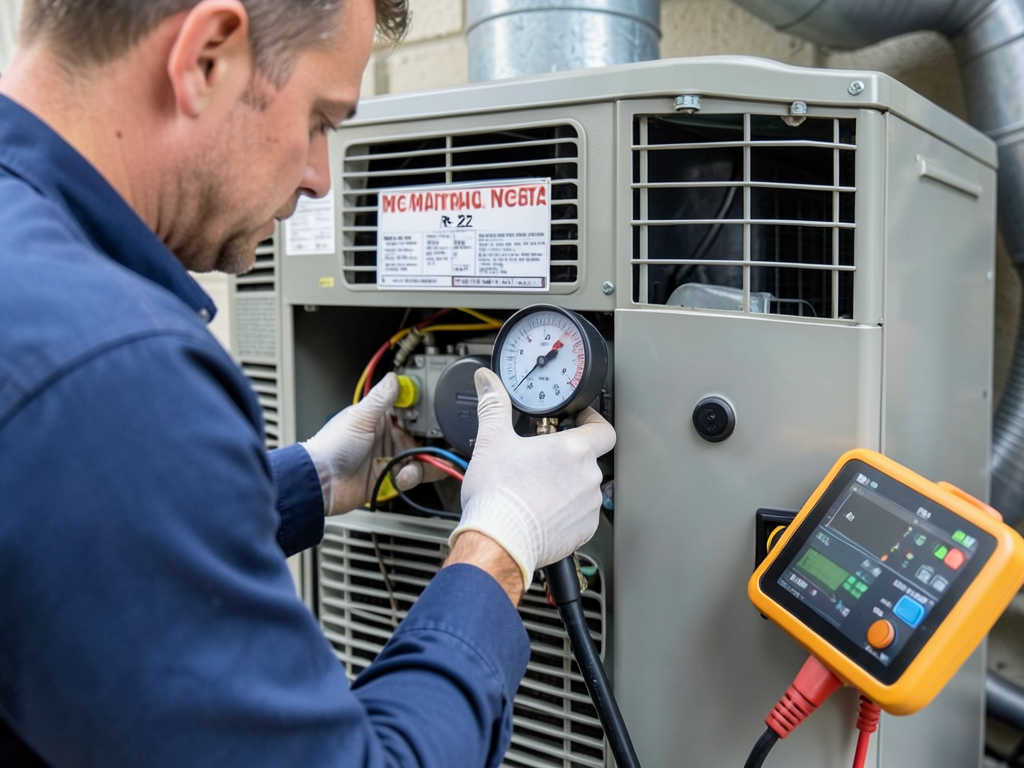
Technician checking refrigerant levels on an older AC unit showing R-22 label
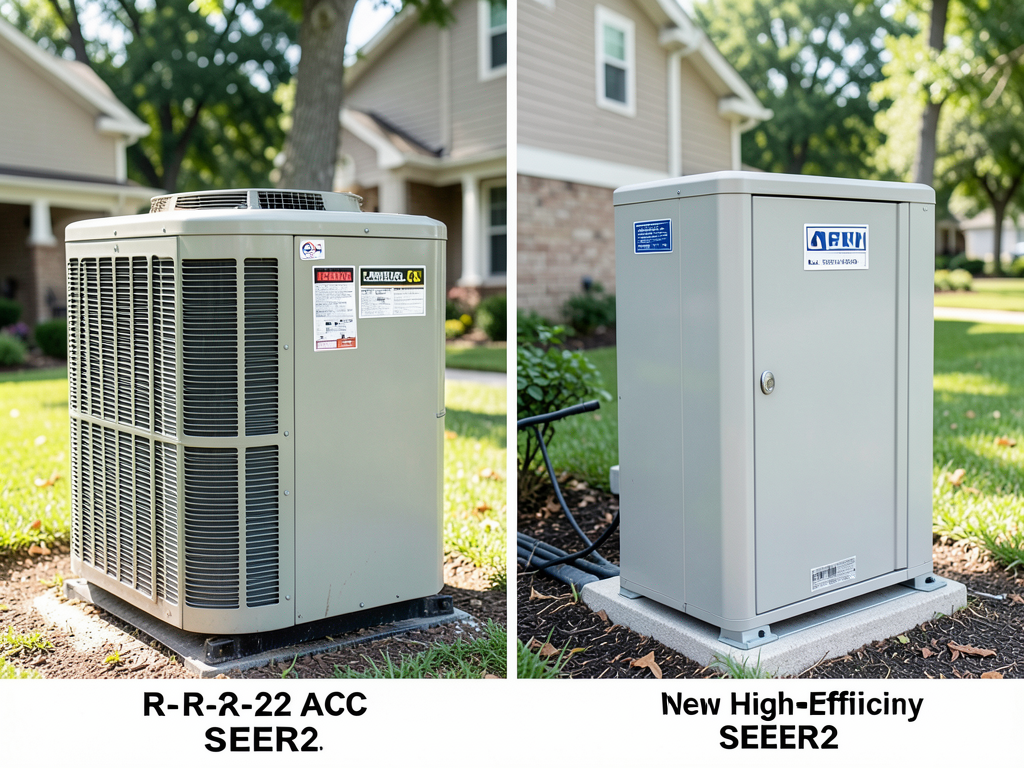
Beyond cost, R-22 units operate at lower efficiency than modern systems. A 10-year-old R-22 unit might have a SEER rating of 10-12, while new units start at SEER 14 and go up to SEER 20+. That efficiency difference translates to 30-50% higher cooling costs.
Energy Efficiency: SEER2 Ratings and Your Indiana Utility Bill
Since January 1, 2023, the Department of Energy requires all new AC units to meet SEER2 standards, which are about 4-5% more stringent than the old SEER ratings. This change affects Indiana homeowners directly through utility costs. Department of Energy AC Efficiency Guidelines.
A SEER2 rating of 14 means your system delivers 14 BTUs of cooling per watt of electricity. Older units might rate 10 or below. The difference adds up quickly in Indiana’s climate.
Consider a typical 3-ton AC running 900 hours per cooling season. At Indiana’s average electricity rate of $0.13 per kWh:
- SEER 10 unit: ~$1,170 annual cooling cost
- SEER 16 unit: ~$730 annual cooling cost
- SEER 20 unit: ~$585 annual cooling cost
Over five years, upgrading from SEER 10 to SEER 20 saves $2,925 in electricity alone. Add Indiana’s humid summers where AC runs longer, and those savings increase.
Cost Analysis: Repairing a Compressor vs. Full System Replacement
Let’s break down real numbers for a typical Clermont home with a 3-ton AC system.
| Repair Option | Estimated Cost | Expected Lifespan | Annual Energy Cost |
|---|---|---|---|
| Compressor Replacement | $1,800-2,500 | 2-3 years | $900 |
| Full System Replacement (SEER 16) | $4,500-5,500 | 12-15 years | $730 |
Over five years, the compressor repair option costs $3,900-4,000 including energy, while replacement costs $5,225-6,275. The repair seems cheaper until you factor in the likelihood of another major repair within those five years.
Most compressor replacements fail again within 2-3 years on older units because other components are also wearing out. The contactor, capacitor, and fan motor often fail soon after, creating a cascade of repairs.
Local Incentives: Indianapolis Rebates and Federal Tax Credits (2026)
Indiana homeowners can significantly reduce replacement costs through various incentives. AES Indiana and Duke Energy both offer rebates for high-efficiency AC installations.
AES Indiana provides up to $400 for SEER2-rated systems installed by certified contractors. Duke Energy offers similar rebates ranging from $150-350 depending on efficiency ratings. These rebates require specific SEER2 minimums and must be claimed through participating contractors.
The federal government offers a 30% tax credit under the Energy Efficient Home Improvement Credit for qualifying HVAC systems. For a $5,000 system, that’s a $1,500 credit directly on your taxes. Unlike deductions, credits reduce your tax bill dollar-for-dollar.
Local utility rebates combined with federal credits can reduce your net replacement cost by $1,500-2,000, making the financial case for replacement much stronger.
Humidity Control and Evaporator Coil Health
Central Indiana’s humidity creates unique challenges for AC systems. Your evaporator coil does double duty—cooling air and removing moisture. When humidity exceeds 60%, which happens frequently in Indianapolis summers, your coil works overtime.. Read more about What Indianapolis Renters Need to Know About Landlord Responsibilities for Broken AC.
Older coils develop mineral deposits and corrosion that reduce heat transfer efficiency by 15-25%. This forces your system to run longer cycles, increasing wear on compressors and fans. The problem compounds because longer run times create more condensation, accelerating coil deterioration.
A healthy coil in a humid climate should maintain a temperature differential of 15-20 degrees between supply and return air. When that differential drops below 12 degrees, your system can’t remove humidity effectively, leaving your home feeling clammy despite cool air.. Read more about What Near Northside Landlords Should Look for in a Low-Maintenance HVAC System.
Modern systems with variable-speed blowers and enhanced coil designs handle humidity much better. They can maintain optimal coil temperatures while adjusting airflow to maximize moisture removal.
Total Cost of Ownership: The Real Number You Need
Stop thinking about individual repair costs. Start calculating total cost of ownership (TCO) over the next five years.
TCO includes: purchase price, installation, energy costs, repairs, and the value of your time dealing with breakdowns. Here’s how it breaks down:
| Time Period | Keep Repairing | Replace Now |
|---|---|---|
| Year 1 | $1,200 (repairs + energy) | $5,500 (system + install) |
| Year 2 | $1,400 | $730 |
| Year 3 | $1,600 | $730 |
| Year 4 | $1,800 | $730 |
| Year 5 | $2,000 | $730 |
| Total 5-Year TCO | $8,000 | $8,450 |
The numbers are close, but the replacement option includes a new warranty, better efficiency, and no emergency repair calls. Plus, repair costs tend to escalate as units age, making the five-year projection conservative.
Call (317) 688-8818 today to schedule your inspection and get a clear picture of your AC’s true costs.
Making the Final Decision: Your Repair vs. Replace Checklist
Before making your decision, run through this checklist:
- Calculate your 50% threshold. Multiply your system’s age by repair cost. If it exceeds 50% of replacement cost, replacement wins.
- Check your refrigerant type. R-22 units should almost always be replaced due to phase-out costs.
- Review your energy bills. Unexplained increases suggest efficiency losses that repairs won’t fix.
- Count your repairs. More than two major repairs in two years signals systemic problems.
- Consider your comfort. If your home feels humid or has hot spots despite cooling, your system is failing.
Still unsure? A professional inspection can reveal hidden problems and provide accurate cost estimates for both repair and replacement options.
Frequently Asked Questions
How long should an AC unit last in Indianapolis?
Most AC units in Central Indiana last 12-15 years with proper maintenance. Our humid climate and temperature extremes can shorten lifespan to 10-12 years for units that run constantly or lack regular maintenance.
Is it worth repairing a 15-year-old AC unit?
Generally no. At 15 years, even a successful repair buys you only 1-2 more years before other components fail. The 50% rule almost always favors replacement at this age, especially considering efficiency improvements in newer units.
What SEER rating should I choose for a replacement?
For most Indianapolis homes, SEER2 16-18 offers the best balance of upfront cost and long-term savings. Higher SEER ratings cost more initially but save more on energy bills. Your payback period depends on how many cooling hours your home requires annually.
How much can I save by upgrading from an old unit?
Homeowners upgrading from SEER 10 units to SEER 16 typically save 30-40% on cooling costs. For a typical home spending $1,000 annually on cooling, that’s $300-400 in yearly savings, or $3,000-4,000 over the system’s lifetime.
Don’t wait until your AC fails on the hottest day of the year. Call (317) 688-8818 to schedule your inspection and get honest advice about whether to repair or replace your Clermont AC unit.
Indiana Residential Code compliance and all work performed by licensed HVAC professionals. Rebate availability and tax credit amounts subject to change based on utility programs and federal guidelines.
You may also find this helpful. How to Fit High-Velocity Air Conditioning into an Old Northside Historic Home.
You may also find this helpful. Carrier versus Trane — Which Brand Handles the Indiana Climate Best?.
{
“@context”: “https://schema.org”,
“@type”: “BlogPosting”,
“headline”: “How to Know if Your Clermont AC Unit is Just a Money Pit (The 50 Percent Rule)”,
“description”: “Learn the 50% rule for AC repairs in Clermont. Discover when to stop fixing your unit and invest in a new one with Indiana-specific cost analysis.”,
“wordCount”: 1822,
“datePublished”: “2026-04-19T10:09:00.000Z”,
“dateModified”: “2026-04-19T10:09:00.000Z”,
“inLanguage”: “en-US”,
“mainEntityOfPage”: {
“@type”: “WebPage”,
“@id”: “https://reliancehvacindianapolis.com”
},
“publisher”: {
“@type”: “LocalBusiness”,
“name”: “Reliance HVAC Indianapolis”,
“url”: “https://reliancehvacindianapolis.com”
},
“author”: {
“@type”: “Organization”,
“name”: “Reliance HVAC Indianapolis”,
“url”: “https://reliancehvacindianapolis.com”
},
“image”: {
“@type”: “ImageObject”,
“url”: “https://reliancehvacindianapolis.com/wp-content/uploads/2026/03/how-to-know-if-your-clermont-ac-unit-is-just-a-mon-1.png”
}
}
{
“@context”: “https://schema.org”,
“@type”: “HVACBusiness”,
“name”: “Reliance HVAC Indianapolis”,
“url”: “https://reliancehvacindianapolis.com”,
“address”: {
“@type”: “PostalAddress”,
“addressLocality”: “Indianapolis”
},
“areaServed”: {
“@type”: “City”,
“name”: “Indianapolis”
}
}
{
“@context”: “https://schema.org”,
“@type”: “FAQPage”,
“mainEntity”: [
{
“@type”: “Question”,
“name”: “How long should an AC unit last in Indianapolis?”,
“acceptedAnswer”: {
“@type”: “Answer”,
“text”: “Most AC units in Central Indiana last 12-15 years with proper maintenance. Our humid climate and temperature extremes can shorten lifespan to 10-12 years for units that run constantly or lack regular maintenance.”
}
},
{
“@type”: “Question”,
“name”: “Is it worth repairing a 15-year-old AC unit?”,
“acceptedAnswer”: {
“@type”: “Answer”,
“text”: “Generally no. At 15 years, even a successful repair buys you only 1-2 more years before other components fail. The 50% rule almost always favors replacement at this age, especially considering efficiency improvements in newer units.”
}
},
{
“@type”: “Question”,
“name”: “What SEER rating should I choose for a replacement?”,
“acceptedAnswer”: {
“@type”: “Answer”,
“text”: “For most Indianapolis homes, SEER2 16-18 offers the best balance of upfront cost and long-term savings. Higher SEER ratings cost more initially but save more on energy bills. Your payback period depends on how many cooling hours your home requires annually.”
}
},
{
“@type”: “Question”,
“name”: “How much can I save by upgrading from an old unit?”,
“acceptedAnswer”: {
“@type”: “Answer”,
“text”: “Homeowners upgrading from SEER 10 units to SEER 16 typically save 30-40% on cooling costs. For a typical home spending $1,000 annually on cooling, that’s $300-400 in yearly savings, or $3,000-4,000 over the system’s lifetime.”
}
}
]
}
{
“@context”: “https://schema.org”,
“@type”: “BreadcrumbList”,
“itemListElement”: [
{
“@type”: “ListItem”,
“position”: 1,
“name”: “Home”,
“item”: “https://reliancehvacindianapolis.com”
},
{
“@type”: “ListItem”,
“position”: 2,
“name”: “Blog”,
“item”: “https://reliancehvacindianapolis.com/blog”
},
{
“@type”: “ListItem”,
“position”: 3,
“name”: “How to Know if Your Clermont AC Unit is Just a Money Pit (The 50 Percent Rule)”
}
]
}
{
“@context”: “https://schema.org”,
“@type”: “Service”,
“serviceType”: “HVAC”,
“provider”: {
“@type”: “LocalBusiness”,
“name”: “Reliance HVAC Indianapolis”,
“url”: “https://reliancehvacindianapolis.com”
},
“areaServed”: {
“@type”: “City”,
“name”: “Indianapolis”
},
“description”: “Learn the 50% rule for AC repairs in Clermont. Discover when to stop fixing your unit and invest in a new one with Indiana-specific cost analysis.”
}