
Making an Attic Bedroom Actually Comfortable in Your Older Irvington Home
Attic bedrooms in Irvington’s historic homes are notorious for temperature swings. Hot in summer, cold in winter, and often uncomfortable year-round. The problem isn’t just the HVAC system—it’s the stack effect, poor insulation, and Indianapolis’s extreme humidity working against you. The good news is that with the right approach, you can make that third-floor space as comfortable as the rest of your home.
Before you invest in any solution, you need to understand why your attic bedroom struggles. Heat rises naturally through your home, creating a pressure difference that pulls warm air upward. In winter, this means your attic steals heat from lower floors. In summer, it becomes a hot box that your existing HVAC system can’t effectively cool. Add Irvington’s high humidity—often above 70% in summer—and you have a space that feels damp and stuffy even when the temperature is technically comfortable.
The first step is a proper load calculation. A Manual J assessment measures exactly how much heating and cooling your attic bedroom needs based on square footage, insulation, windows, and local climate data. For Irvington homes, most finished attics need 6,000-12,000 BTUs of additional capacity. Without this calculation, you’re guessing—and guessing costs more in the long run. Reliable Heating and Cooling Experts Serving the Broad Ripple Area.
Option 1: Ductless Mini-Split Systems (The Gold Standard)
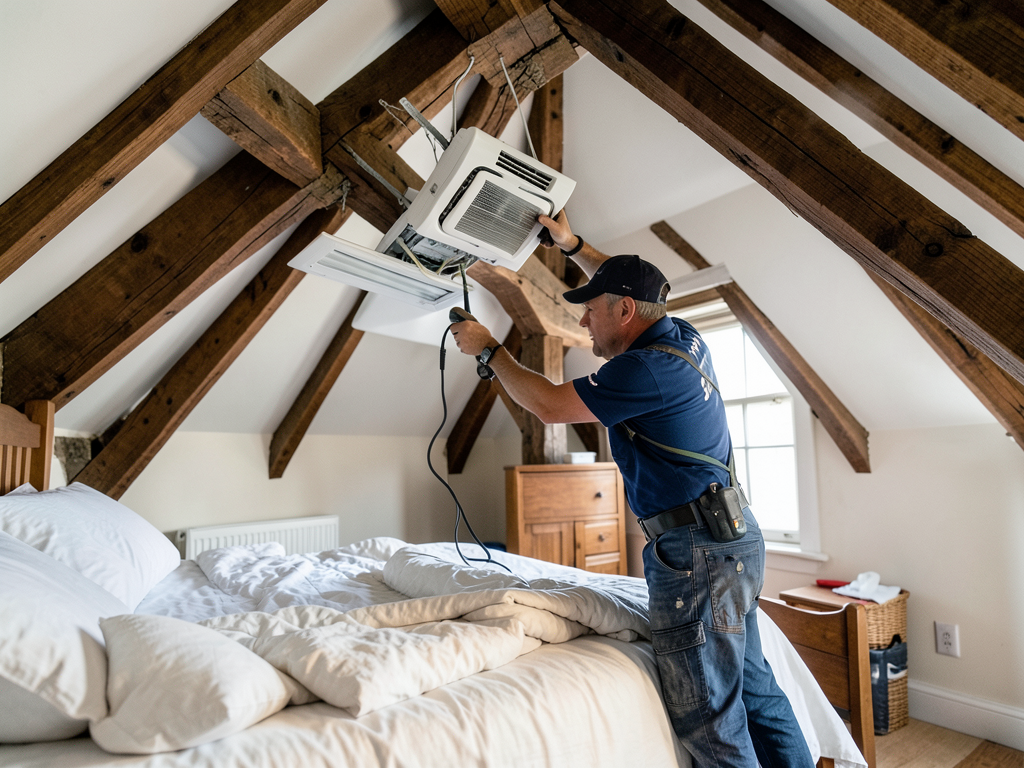
Ductless mini-splits are the most effective solution for Irvington attic bedrooms. These systems have two main components: an outdoor compressor and one or more indoor air handlers mounted on your wall or ceiling. The indoor unit connects to the outdoor unit through a small refrigerant line that runs through a three-inch hole in your wall—no bulky ductwork required.
The technology works exceptionally well in Irvington for several reasons. First, mini-splits provide both heating and cooling, so you’re covered year-round. Second, they operate independently of your main HVAC system, meaning you can set different temperatures for different floors. Third, modern mini-splits maintain efficiency even when outdoor temperatures drop below zero—critical for those occasional Arctic blasts that hit Central Indiana.
Installation is straightforward but requires professional expertise. The indoor unit mounts to your wall or ceiling, the refrigerant line runs through your exterior wall to the outdoor unit, and a condensate drain removes moisture. Most Irvington installations take one to two days. The electrical requirements are minimal—usually just a dedicated 220-volt circuit.
Cost factors include the unit’s capacity (measured in BTUs), the number of indoor units, and installation complexity. For a typical Irvington attic bedroom of 300-400 square feet, expect to invest $3,500-$5,500 for a complete system. This includes the outdoor unit, indoor air handler, installation labor, and electrical work.
The energy efficiency is impressive. Most mini-splits achieve SEER2 ratings of 18-22, meaning they use significantly less electricity than older systems. Over time, the energy savings can offset the initial investment, especially if you’re currently overheating or overcooling your entire home to make the attic comfortable.
Option 2: Extending Existing HVAC & Zoning

If your existing HVAC system has enough capacity, extending ductwork to your attic bedroom might be an option. However, this approach has significant limitations in Irvington homes. Most historic properties weren’t designed with third-floor climate control in mind, and your furnace or air conditioner may already be operating near its maximum capacity. Furnace Blowing Cold Air.
The first question is capacity. Your system’s ability to handle additional load depends on its age, efficiency, and current usage. A professional load calculation will tell you whether your equipment can support another zone. Many Irvington homes built before 2000 simply don’t have the excess capacity needed for attic conditioning. Excess Dust in Home.
If capacity exists, the next consideration is ductwork. Running new ducts to a third floor means cutting through walls, floors, and ceilings—often in ways that aren’t possible in historic homes without significant structural modifications. The ducts themselves need proper insulation and sealing to prevent energy loss.
Zoning is essential if you extend your system. A zoning system uses motorized dampers in your ductwork to direct conditioned air where it’s needed. Without zoning, your attic might get too much air while your main floor gets too little. Modern zoning controls allow you to set different temperatures for different areas of your home through a smartphone app or wall-mounted thermostat.
The cost to extend and zone your system ranges from $2,500-$6,000, depending on the complexity of the installation and whether your existing equipment needs upgrades. However, if your system can’t handle the additional load, you’ll face a much larger expense: $8,000-$15,000 to replace your furnace and air conditioner with higher-capacity units.. Read more about Modernizing Your Fall Creek Place Cottage with a Compact HVAC System.
Energy efficiency is another concern. Duct losses in unconditioned spaces can account for 30% of energy consumption in forced-air systems. In an attic, where temperatures can reach 130°F in summer, those losses are even higher. Proper duct insulation becomes critical, adding to the overall cost.
Option 3: Heat Pump Technology for Year-Round Comfort
Modern cold-climate heat pumps offer an alternative that’s gaining popularity in Irvington. Unlike traditional heat pumps that struggle when temperatures drop below freezing, today’s cold-climate models maintain efficiency down to -15°F. This makes them viable for year-round attic conditioning in Central Indiana.
Heat pumps work by moving heat rather than generating it. In summer, they remove heat from your attic and release it outside. In winter, they extract heat from outdoor air—even when it feels cold to you—and bring it inside. The technology has advanced significantly, with many models now achieving heating efficiencies of 300% or higher.
For attic applications, heat pumps offer several advantages. They provide both heating and cooling from a single unit, eliminating the need for separate systems. They’re highly efficient, often achieving SEER2 ratings above 20. And they can integrate with your existing HVAC system through a hybrid setup, where the heat pump handles most of the load and your furnace provides backup during extreme cold. EPA duct cleaning information.
Installation considerations are similar to mini-splits but with some key differences. Heat pumps require an outdoor unit and an indoor air handler, but the indoor unit can be ducted or ductless depending on your preference. Ducted heat pumps can use existing ductwork if it’s in good condition, while ductless models offer the same benefits as mini-splits.
Cost for a heat pump system ranges from $4,000-$8,000, depending on capacity and whether you need new ductwork. The higher end of that range typically includes a cold-climate model with premium features like variable-speed compressors and smart controls.
Energy efficiency is where heat pumps shine. They can reduce heating costs by 50-70% compared to electric resistance heating and 30-50% compared to propane or oil. In cooling mode, they’re comparable to high-efficiency air conditioners. For Irvington homeowners looking to reduce their carbon footprint while improving comfort, heat pumps are an excellent choice.
The Importance of Insulation & Ventilation
No HVAC solution will work effectively if your attic lacks proper insulation and ventilation. In Irvington’s climate, this means addressing both heat gain in summer and heat loss in winter.
Attic insulation requirements in Central Indiana follow International Residential Code guidelines, which recommend R-49 to R-60 for attics. Many Irvington homes have only R-19 to R-30, leaving significant energy savings on the table. Upgrading insulation costs $1,500-$3,000 for a typical attic bedroom but can reduce heating and cooling loads by 20-30%.
The type of insulation matters. Fiberglass batts are inexpensive but don’t seal gaps as effectively as blown-in cellulose or spray foam. Spray foam provides the best air sealing and highest R-value per inch, but costs $2-$3 per square foot installed. For knee walls—the short walls that meet your attic floor—rigid foam board with taped seams creates an effective thermal barrier.
Ventilation is equally important. Without proper airflow, moisture accumulates in your attic, leading to mold growth and reduced insulation effectiveness. Soffit vents allow cool air to enter at the eaves while ridge vents or gable vents let hot air escape at the roof peak. This natural convection keeps your attic closer to outdoor temperatures rather than allowing it to become a heat trap.
Baffles—cardboard or plastic channels installed between rafters—ensure that insulation doesn’t block soffit vents. Without baffles, you might trap moisture against your roof deck, causing rot and reducing your roof’s lifespan. Proper ventilation costs $500-$1,500 but protects your entire home, not just your attic bedroom.
Moisture control is critical in Irvington’s humid climate. A standalone dehumidifier can remove 30-70 pints of moisture per day, costing $1,000-$2,500 installed. This prevents that clammy feeling that makes even a cool attic uncomfortable. Some mini-splits include dehumidification modes, but in extremely humid conditions, a dedicated unit provides better control.
What Does Attic HVAC Installation Cost in Central Indiana?
Understanding the cost factors helps you budget appropriately and avoid surprises. Several variables influence the final price of making your attic bedroom comfortable.
Square footage is the primary determinant. A 200-square-foot attic bedroom needs less capacity than a 500-square-foot space. BTU requirements scale accordingly, affecting equipment size and cost. Most Irvington attic bedrooms fall between 250 and 400 square feet.
Existing infrastructure plays a major role. If you already have ductwork in the attic, extending it might be cheaper than installing a new system. However, old ductwork often has leaks and poor insulation, reducing efficiency. A professional inspection can determine whether repair or replacement makes more sense. The Best AC Repair Services in Carmel for Modern Subdivisions.
Electrical upgrades are common in older Irvington homes. Many don’t have the dedicated circuits needed for modern HVAC equipment. Adding a new 220-volt circuit costs $300-$600 but is essential for safe, reliable operation. Some installations require electrical panel upgrades, which can add $1,000-$2,500 to your project.
Building permits are required for most HVAC installations in Marion County. The permit process ensures your installation meets local codes and passes inspection. Permit fees range from $75-$250, and your HVAC contractor should handle the paperwork as part of your project.
Energy efficiency incentives can offset costs. AES Indiana and Duke Energy offer rebates for high-efficiency equipment, typically $300-$600 for systems with SEER2 ratings above 16. Federal tax credits may also apply, providing up to 30% of installation costs for qualifying equipment.
Here’s a comparison of typical costs for different solutions:
| Solution Type | Equipment Cost | Installation Cost | Total Investment | Typical ROI Period |
|---|---|---|---|---|
| Ductless Mini-Split | $2,000-$4,000 | $1,500-$2,000 | $3,500-$6,000 | 3-5 years |
| Extended Ductwork + Zoning | $1,000-$2,500 | $1,500-$3,500 | $2,500-$6,000 | 5-7 years |
| Cold-Climate Heat Pump | $2,500-$5,000 | $1,500-$3,000 | $4,000-$8,000 | 4-6 years |
| Traditional Furnace/AC Upgrade | $4,000-$8,000 | $2,000-$4,000 | $6,000-$12,000 | 7-10 years |
Energy savings vary by solution. Mini-splits typically reduce heating and cooling costs by 20-30% compared to inefficient systems. Heat pumps can achieve 30-50% savings. Traditional systems with zoning see 15-25% reductions. These savings, combined with improved comfort, make most investments worthwhile within a few years.
Maintenance requirements also differ. Mini-splits need annual cleaning of filters and coils. Traditional systems require regular filter changes and annual professional maintenance. Heat pumps have similar maintenance needs to air conditioners but may require additional attention to outdoor units in winter.
The best solution for your Irvington attic bedroom depends on your specific situation. Consider your existing HVAC system’s capacity, your budget, and your long-term plans for the home. A professional assessment can help you weigh these factors and choose the most cost-effective approach.
Ready to make your attic bedroom comfortable year-round? Call (317) 688-8818 today to schedule your free assessment. Our NATE-certified technicians will evaluate your space, calculate your heating and cooling needs, and recommend the best solution for your Irvington home.
Frequently Asked Questions
How long does it take to install HVAC in an attic bedroom?
Most attic HVAC installations take 1-3 days, depending on the complexity. Mini-splits typically install in one day, while extending ductwork or installing a heat pump may require two to three days for proper setup and testing.
Will adding HVAC to my attic increase my energy bills?
Properly sized and installed attic HVAC should maintain or slightly increase your energy bills while dramatically improving comfort. High-efficiency systems like mini-splits often reduce overall energy consumption by allowing you to heat and cool only the spaces you’re using.
Do I need a permit to install HVAC in my attic?
Yes, Marion County requires permits for most HVAC installations. The permit ensures your installation meets local building codes and passes inspection. Professional HVAC contractors typically handle permit acquisition as part of your project.
Can I install attic HVAC myself to save money?
HVAC installation requires specialized knowledge, tools, and licensing in Indiana. DIY installation can void equipment warranties, create safety hazards, and result in inefficient operation. Professional installation ensures proper sizing, safe operation, and code compliance.
What’s the best HVAC solution for an older Irvington home?
Ductless mini-splits are often ideal for older Irvington homes because they don’t require extensive modifications to historic structures. They provide efficient heating and cooling without the need for new ductwork, preserving your home’s character while improving comfort.
How do I know what size HVAC system I need for my attic?
A Manual J load calculation is the only accurate way to determine HVAC sizing. This professional assessment considers your attic’s square footage, insulation, windows, local climate, and other factors to calculate exact heating and cooling requirements.
Don’t let another season pass with an uncomfortable attic bedroom. Pick up the phone and call (317) 688-8818 before the next temperature extreme hits. Our team serves all of Irvington and surrounding Indianapolis neighborhoods with rapid, reliable HVAC solutions that actually work. For more information, visit Energy.gov heat pump guide.
You may also find this helpful. Converting a Screened Porch into a Year Round Room in Homecroft.
{
“@context”: “https://schema.org”,
“@type”: “BlogPosting”,
“headline”: “Making an Attic Bedroom Actually Comfortable in Your Older Irvington Home”,
“description”: “Struggling with temperature swings in your Irvington attic bedroom? Discover HVAC solutions like mini-splits, zoning, and insulation that actually work in Indianapolis’s humid climate.”,
“wordCount”: 2250,
“datePublished”: “2026-05-18T11:16:00.000Z”,
“dateModified”: “2026-05-18T11:16:00.000Z”,
“inLanguage”: “en-US”,
“mainEntityOfPage”: {
“@type”: “WebPage”,
“@id”: “https://reliancehvacindianapolis.com”
},
“publisher”: {
“@type”: “LocalBusiness”,
“name”: “Reliance HVAC Indianapolis”,
“url”: “https://reliancehvacindianapolis.com”
},
“author”: {
“@type”: “Organization”,
“name”: “Reliance HVAC Indianapolis”,
“url”: “https://reliancehvacindianapolis.com”
},
“image”: {
“@type”: “ImageObject”,
“url”: “https://reliancehvacindianapolis.com/wp-content/uploads/2026/03/making-an-attic-bedroom-actually-comfortable-in-yo-1.png”
}
}
{
“@context”: “https://schema.org”,
“@type”: “HVACBusiness”,
“name”: “Reliance HVAC Indianapolis”,
“url”: “https://reliancehvacindianapolis.com”,
“address”: {
“@type”: “PostalAddress”,
“addressLocality”: “Indianapolis”
},
“areaServed”: {
“@type”: “City”,
“name”: “Indianapolis”
}
}
{
“@context”: “https://schema.org”,
“@type”: “FAQPage”,
“mainEntity”: [
{
“@type”: “Question”,
“name”: “What Does Attic HVAC Installation Cost in Central Indiana?”,
“acceptedAnswer”: {
“@type”: “Answer”,
“text”: “Understanding the cost factors helps you budget appropriately and avoid surprises. Several variables influence the final price of making your attic bedroom comfortable.”
}
},
{
“@type”: “Question”,
“name”: “Will adding HVAC to my attic increase my energy bills?”,
“acceptedAnswer”: {
“@type”: “Answer”,
“text”: “Properly sized and installed attic HVAC should maintain or slightly increase your energy bills while dramatically improving comfort. High-efficiency systems like mini-splits often reduce overall energy consumption by allowing you to heat and cool only the spaces you’re using.”
}
},
{
“@type”: “Question”,
“name”: “Do I need a permit to install HVAC in my attic?”,
“acceptedAnswer”: {
“@type”: “Answer”,
“text”: “Yes, Marion County requires permits for most HVAC installations. The permit ensures your installation meets local building codes and passes inspection. Professional HVAC contractors typically handle permit acquisition as part of your project.”
}
},
{
“@type”: “Question”,
“name”: “Can I install attic HVAC myself to save money?”,
“acceptedAnswer”: {
“@type”: “Answer”,
“text”: “HVAC installation requires specialized knowledge, tools, and licensing in Indiana. DIY installation can void equipment warranties, create safety hazards, and result in inefficient operation. Professional installation ensures proper sizing, safe operation, and code compliance.”
}
},
{
“@type”: “Question”,
“name”: “What’s the best HVAC solution for an older Irvington home?”,
“acceptedAnswer”: {
“@type”: “Answer”,
“text”: “Ductless mini-splits are often ideal for older Irvington homes because they don’t require extensive modifications to historic structures. They provide efficient heating and cooling without the need for new ductwork, preserving your home’s character while improving comfort.”
}
},
{
“@type”: “Question”,
“name”: “How do I know what size HVAC system I need for my attic?”,
“acceptedAnswer”: {
“@type”: “Answer”,
“text”: “A Manual J load calculation is the only accurate way to determine HVAC sizing. This professional assessment considers your attic’s square footage, insulation, windows, local climate, and other factors to calculate exact heating and cooling requirements.”
}
}
]
}
{
“@context”: “https://schema.org”,
“@type”: “BreadcrumbList”,
“itemListElement”: [
{
“@type”: “ListItem”,
“position”: 1,
“name”: “Home”,
“item”: “https://reliancehvacindianapolis.com”
},
{
“@type”: “ListItem”,
“position”: 2,
“name”: “Blog”,
“item”: “https://reliancehvacindianapolis.com/blog”
},
{
“@type”: “ListItem”,
“position”: 3,
“name”: “Making an Attic Bedroom Actually Comfortable in Your Older Irvington Home”
}
]
}
{
“@context”: “https://schema.org”,
“@type”: “Service”,
“serviceType”: “HVAC”,
“provider”: {
“@type”: “LocalBusiness”,
“name”: “Reliance HVAC Indianapolis”,
“url”: “https://reliancehvacindianapolis.com”
},
“areaServed”: {
“@type”: “City”,
“name”: “Indianapolis”
},
“description”: “Struggling with temperature swings in your Irvington attic bedroom? Discover HVAC solutions like mini-splits, zoning, and insulation that actually work in Indianapolis’s humid climate.”
}