
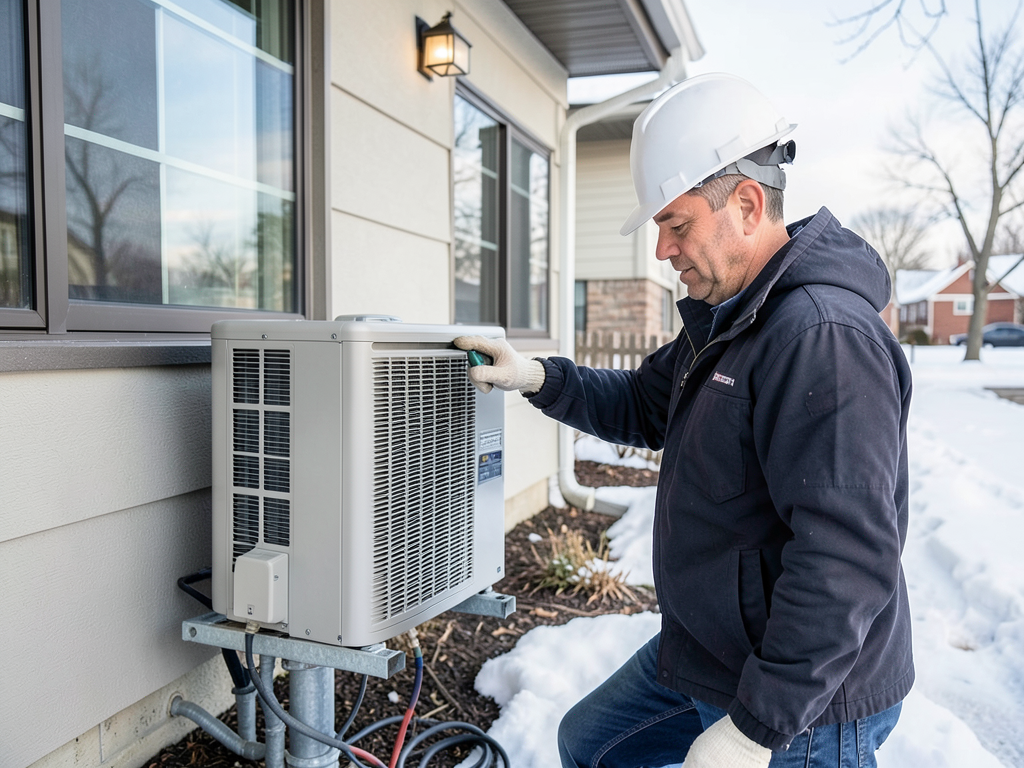
Upgrading Your Carmel Home with a High Efficiency Heat Pump
Indiana winters test every heating system. A high-efficiency heat pump delivers both heating and cooling from one unit. Modern cold-climate models now work reliably even when temperatures drop below zero. For Carmel homeowners, this means lower energy bills, quieter operation, and year-round comfort without relying solely on fossil fuels. ENERGY STAR heat pump requirements.
Heat pumps transfer heat instead of creating it. In winter, they pull warmth from outdoor air. In summer, they reverse the process to cool your home. The technology has improved dramatically. Today’s units achieve efficiencies over 300% compared to 80-95% for gas furnaces. That means three units of heat for every one unit of electricity used. Furnace Blowing Cold Air.
Why Carmel Homeowners Are Switching to Heat Pumps
Carmel’s humid continental climate creates unique heating and cooling demands. Summers bring heat indexes above 100 degrees with sticky humidity. Winters deliver sub-zero cold snaps that can last for days. Traditional air conditioners struggle with humidity while gas furnaces create dry indoor air that irritates sinuses.
Heat pumps handle both extremes. They dehumidify better than standard AC units during summer. In winter, they maintain consistent temperatures without the temperature swings common with furnace cycling. The steady airflow also improves indoor air quality by constantly filtering and circulating air. How Much Does a New AC Unit Cost for a Standard Zionsville Home?.
Local energy costs make heat pumps attractive. Electricity rates in Hamilton County average 12.5 cents per kilowatt-hour. When paired with proper insulation, a heat pump can cut heating costs by 30-50% compared to electric resistance heat. Many Carmel residents see payback periods under five years.
Expert Installation for All Heat Pump Types
Air source heat pumps dominate the residential market. They extract heat from outdoor air using refrigerant lines. Modern cold-climate models include inverter technology that maintains heating capacity down to -15 degrees Fahrenheit. Some premium units continue working at -22 degrees with reduced efficiency.
Dual-fuel systems combine a heat pump with a backup gas furnace. The heat pump handles heating down to about 30 degrees. Below that temperature, the system automatically switches to the gas furnace. This configuration maximizes efficiency while ensuring reliable heat during extreme cold snaps common in central Indiana.
Ductless mini-split heat pumps work well for additions, sunrooms, or homes without existing ductwork. Each indoor unit operates independently with its own thermostat. This zoning capability can reduce energy waste by heating or cooling only occupied rooms. Installation requires only a small hole for refrigerant lines through exterior walls.
Our Carmel-Specific Installation Process
Professional heat pump installation starts with a Manual J load calculation. This engineering analysis determines the exact heating and cooling capacity needed for your home. Factors include square footage, insulation levels, window orientation, and local climate data for Carmel’s Zone 5A climate zone.
Proper sizing prevents short cycling and ensures efficiency. An oversized unit cools too quickly without removing humidity. An undersized unit runs constantly during extreme weather. Our calculations use ACCA-approved software and consider Carmel’s specific temperature extremes recorded over the past 20 years.
Installation includes evaluating your existing ductwork. Many Carmel homes built before 2000 have leaky ducts that waste 20-30% of conditioned air. We seal and insulate accessible ducts to maximize system performance. For homes without ducts, we design concealed line sets that preserve architectural integrity.
Post-installation testing verifies proper refrigerant charge, airflow, and thermostat operation. We use digital manifold gauges to confirm manufacturer specifications. Sound level measurements ensure units operate below 60 decibels at the property line, meeting Carmel’s noise ordinances for residential zones.
Local Rebates and Federal Tax Credits
The federal government offers up to $2,000 in tax credits for qualifying heat pump installations under the Inflation Reduction Act. The credit covers 30% of installation costs including labor. Equipment must meet minimum efficiency standards: SEER2 of 16 and HSPF2 of 8.2 for split systems. Inflation Reduction Act tax credits.
Duke Energy’s Smart $aver® program provides rebates for high-efficiency heat pumps. Homeowners can receive up to $600 for qualifying air source heat pumps. The program requires installation by participating contractors who verify equipment meets program specifications. Applications must be submitted within 60 days of installation.
Carmel Utilities offers additional incentives for electric heating upgrades. The Going Electric program provides rebates up to $1,000 for replacing gas furnaces with electric heat pumps. The program aims to reduce peak demand during winter months when natural gas infrastructure faces the most stress.
Local utility rebates change annually based on funding availability. We track current programs and handle all paperwork. Most rebates process within 8-12 weeks after installation. Some utilities offer instant rebates through participating contractors, reducing upfront costs.
Heat Pump FAQ for Hamilton County Residents
How do heat pumps perform during Carmel’s coldest winters?
Modern cold-climate heat pumps maintain heating capacity down to -15 degrees Fahrenheit. During extreme cold snaps, they operate at reduced efficiency but still provide heat. Most Indiana homeowners never experience temperatures cold enough to disable these units. Backup electric resistance heat strips activate only when needed.
Are heat pumps noisy for close-proximity neighborhoods?
Today’s units operate at 50-60 decibels, similar to a refrigerator. Proper installation includes sound blankets and strategic placement away from bedroom windows. We use rubber isolation mounts to prevent vibration transmission to walls. Most Carmel installations meet the 60-decibel limit at property lines.
What maintenance do heat pumps require?
Annual professional maintenance includes checking refrigerant levels, cleaning coils, and testing electrical components. Homeowners should change filters every 1-3 months depending on usage. Heat pumps have fewer moving parts than furnaces, reducing long-term maintenance costs. Most systems operate reliably for 15-20 years with proper care. Filter Replacement Services.
Can I keep my existing furnace as backup?
Yes. Dual-fuel systems automatically switch between heat pump and furnace based on outdoor temperature. This provides the best of both worlds: heat pump efficiency during mild weather and furnace reliability during extreme cold. The transition happens seamlessly without homeowner intervention.
How long does installation take?
Most replacements complete in one day. New installations may require two days including ductwork modifications. We coordinate with electricians for any necessary electrical upgrades. Permitting through the City of Carmel typically processes within 3-5 business days. Affordable HVAC Replacement Options for Families in Noblesville.
Comparing Heat Pump Efficiency Ratings
SEER2 (Seasonal Energy Efficiency Ratio 2) measures cooling efficiency. Higher numbers indicate better performance. Modern heat pumps achieve SEER2 ratings from 16 to 28. Each point increase can reduce cooling costs by 6-8%. For Carmel’s long cooling season, higher SEER2 ratings provide significant savings.
HSPF2 (Heating Seasonal Performance Factor 2) measures heating efficiency. Ratings range from 8.2 to 12.2 for cold-climate models. A unit with HSPF2 of 10 delivers 10 units of heat for every unit of electricity consumed. This compares favorably to gas furnaces at 80-95% efficiency.
ENERGY STAR certification requires minimum SEER2 of 15 and HSPF2 of 8.5 for split systems. Many premium models exceed these requirements. We recommend minimum SEER2 of 16 and HSPF2 of 9 for optimal performance in central Indiana’s climate.
Operating costs depend on local utility rates and home insulation quality. A typical 2,000-square-foot home in Carmel might see annual heating and cooling costs of $800-1,200 with a high-efficiency heat pump, compared to $1,200-1,800 with a standard system.
Professional Sizing and Manual J Load Calculations
Manual J calculations follow ACCA (Air Conditioning Contractors of America) standards. The process analyzes your home’s heat gain and loss in BTU/hour. We measure insulation R-values, window U-factors, and air infiltration rates. Local climate data for Hamilton County’s Zone 5A region ensures accurate sizing.
Common sizing errors waste energy and reduce comfort. A unit too large cools too quickly without removing humidity. This leaves your home feeling clammy despite comfortable temperatures. Short cycling also increases wear on compressors and reduces system lifespan.
Our calculations consider Carmel’s specific conditions. The city experiences 22 days annually below 10 degrees Fahrenheit. Summer design temperature reaches 92 degrees. These extremes influence equipment selection. We typically add 10-15% capacity for homes with large south-facing windows common in newer Carmel subdivisions.
We provide written load calculations with every proposal. This documentation helps secure utility rebates and ensures compliance with local building codes. The City of Carmel requires Manual J calculations for all new HVAC installations.
Heat Pump vs. Traditional Gas Furnace in Carmel
Heat pumps offer several advantages over gas furnaces in central Indiana. They provide both heating and cooling from one system, eliminating the need for separate air conditioner and furnace. This reduces equipment costs and maintenance requirements.
Safety concerns favor heat pumps. They eliminate risks of carbon monoxide poisoning and gas leaks. No combustion means no need for venting through roofs or walls. This simplifies installation and reduces potential failure points.
Gas furnaces create dry indoor air that requires humidifiers. Heat pumps maintain natural humidity levels, improving comfort and reducing static electricity. The consistent airflow also prevents hot and cold spots common with furnace systems.
Initial costs favor gas furnaces slightly. A standard gas furnace and AC combination typically costs $1,000-2,000 less than a comparable heat pump system. However, heat pumps often qualify for larger rebates and tax credits, reducing the net cost difference.
Operating costs vary with utility rates. When electricity costs less than 15 cents per kilowatt-hour, heat pumps usually cost less to operate than gas furnaces. Hamilton County’s rates currently favor heat pumps for most homes.
Call (317) 688-8818 Today to Schedule Your Inspection
Ready to upgrade your Carmel home with a high-efficiency heat pump? Our NATE-certified technicians provide free in-home consultations. We’ll evaluate your current system, discuss your comfort preferences, and show you exactly how much you can save with available rebates.
Call (317) 688-8818 today to schedule your inspection. Don’t wait until your old system fails during the next cold snap. Our rapid response team can typically install your new heat pump within two weeks of your consultation.
Picking up the phone and calling (317) 688-8818 before the next storm hits could save you thousands in emergency repairs and discomfort. We serve all of Carmel including the Arts & Design District, Village of WestClay, and surrounding Hamilton County neighborhoods. The Best AC Repair Services in Carmel for Modern Subdivisions.
Frequently Asked Questions
How long do heat pumps typically last?
Heat pumps generally last 15-20 years with proper maintenance. Factors affecting lifespan include usage patterns, maintenance frequency, and local climate conditions. Homes in Carmel’s climate zone typically see 17-18 year lifespans from quality equipment.
Can heat pumps handle Indiana’s humidity?
Yes. Heat pumps dehumidify more effectively than standard air conditioners. They run longer cycles at lower speeds, removing more moisture from the air. Most models include enhanced dehumidification modes that can remove 10-15% more humidity than conventional AC units.
What size heat pump do I need?
Size depends on your home’s specific characteristics. A 2,000-square-foot home typically needs 3-4 tons of cooling capacity. Our Manual J calculations consider insulation, windows, orientation, and local climate to determine exact requirements. Guessing leads to inefficiency and discomfort.
Are heat pumps environmentally friendly?
Heat pumps reduce carbon emissions compared to gas furnaces. They use electricity, which increasingly comes from renewable sources. Even when powered by fossil fuel electricity, heat pumps produce fewer emissions than burning natural gas directly. They also eliminate on-site combustion risks.
Do heat pumps work with smart thermostats?
Modern heat pumps integrate seamlessly with smart thermostats. Most manufacturers offer Wi-Fi enabled controls that allow remote monitoring and programming. Smart thermostats can optimize performance by learning your schedule and adjusting operation to maximize efficiency while maintaining comfort.
{
“@context”: “https://schema.org”,
“@type”: “BlogPosting”,
“headline”: “Upgrading Your Carmel Home with a High Efficiency Heat Pump”,
“description”: “Learn how heat pumps perform in Indiana winters and discover local rebates for Carmel homeowners upgrading to high-efficiency systems.”,
“wordCount”: 1929,
“datePublished”: “2026-02-23T13:55:00.000Z”,
“dateModified”: “2026-02-23T13:55:00.000Z”,
“inLanguage”: “en-US”,
“mainEntityOfPage”: {
“@type”: “WebPage”,
“@id”: “https://reliancehvacindianapolis.com”
},
“publisher”: {
“@type”: “LocalBusiness”,
“name”: “Reliance HVAC Indianapolis”,
“url”: “https://reliancehvacindianapolis.com”
},
“author”: {
“@type”: “Organization”,
“name”: “Reliance HVAC Indianapolis”,
“url”: “https://reliancehvacindianapolis.com”
},
“image”: {
“@type”: “ImageObject”,
“url”: “https://reliancehvacindianapolis.com/wp-content/uploads/2026/03/upgrading-your-carmel-home-with-a-high-efficiency-1.png”
}
}
{
“@context”: “https://schema.org”,
“@type”: “HVACBusiness”,
“name”: “Reliance HVAC Indianapolis”,
“url”: “https://reliancehvacindianapolis.com”,
“address”: {
“@type”: “PostalAddress”,
“addressLocality”: “Indianapolis”
},
“areaServed”: {
“@type”: “City”,
“name”: “Indianapolis”
}
}
{
“@context”: “https://schema.org”,
“@type”: “FAQPage”,
“mainEntity”: [
{
“@type”: “Question”,
“name”: “How do heat pumps perform during Carmel’s coldest winters?”,
“acceptedAnswer”: {
“@type”: “Answer”,
“text”: “Modern cold-climate heat pumps maintain heating capacity down to -15 degrees Fahrenheit. During extreme cold snaps, they operate at reduced efficiency but still provide heat. Most Indiana homeowners never experience temperatures cold enough to disable these units. Backup electric resistance heat strips activate only when needed.”
}
},
{
“@type”: “Question”,
“name”: “Are heat pumps noisy for close-proximity neighborhoods?”,
“acceptedAnswer”: {
“@type”: “Answer”,
“text”: “Today’s units operate at 50-60 decibels, similar to a refrigerator. Proper installation includes sound blankets and strategic placement away from bedroom windows. We use rubber isolation mounts to prevent vibration transmission to walls. Most Carmel installations meet the 60-decibel limit at property lines.”
}
},
{
“@type”: “Question”,
“name”: “What maintenance do heat pumps require?”,
“acceptedAnswer”: {
“@type”: “Answer”,
“text”: “Annual professional maintenance includes checking refrigerant levels, cleaning coils, and testing electrical components. Homeowners should change filters every 1-3 months depending on usage. Heat pumps have fewer moving parts than furnaces, reducing long-term maintenance costs. Most systems operate reliably for 15-20 years with proper care. Filter Replacement Services.”
}
},
{
“@type”: “Question”,
“name”: “Can I keep my existing furnace as backup?”,
“acceptedAnswer”: {
“@type”: “Answer”,
“text”: “Yes. Dual-fuel systems automatically switch between heat pump and furnace based on outdoor temperature. This provides the best of both worlds: heat pump efficiency during mild weather and furnace reliability during extreme cold. The transition happens seamlessly without homeowner intervention.”
}
},
{
“@type”: “Question”,
“name”: “How long does installation take?”,
“acceptedAnswer”: {
“@type”: “Answer”,
“text”: “Most replacements complete in one day. New installations may require two days including ductwork modifications. We coordinate with electricians for any necessary electrical upgrades. Permitting through the City of Carmel typically processes within 3-5 business days. Affordable HVAC Replacement Options for Families in Noblesville.”
}
},
{
“@type”: “Question”,
“name”: “How long do heat pumps typically last?”,
“acceptedAnswer”: {
“@type”: “Answer”,
“text”: “Heat pumps generally last 15-20 years with proper maintenance. Factors affecting lifespan include usage patterns, maintenance frequency, and local climate conditions. Homes in Carmel’s climate zone typically see 17-18 year lifespans from quality equipment.”
}
},
{
“@type”: “Question”,
“name”: “Can heat pumps handle Indiana’s humidity?”,
“acceptedAnswer”: {
“@type”: “Answer”,
“text”: “Yes. Heat pumps dehumidify more effectively than standard air conditioners. They run longer cycles at lower speeds, removing more moisture from the air. Most models include enhanced dehumidification modes that can remove 10-15% more humidity than conventional AC units.”
}
},
{
“@type”: “Question”,
“name”: “What size heat pump do I need?”,
“acceptedAnswer”: {
“@type”: “Answer”,
“text”: “Size depends on your home’s specific characteristics. A 2,000-square-foot home typically needs 3-4 tons of cooling capacity. Our Manual J calculations consider insulation, windows, orientation, and local climate to determine exact requirements. Guessing leads to inefficiency and discomfort.”
}
},
{
“@type”: “Question”,
“name”: “Are heat pumps environmentally friendly?”,
“acceptedAnswer”: {
“@type”: “Answer”,
“text”: “Heat pumps reduce carbon emissions compared to gas furnaces. They use electricity, which increasingly comes from renewable sources. Even when powered by fossil fuel electricity, heat pumps produce fewer emissions than burning natural gas directly. They also eliminate on-site combustion risks.”
}
},
{
“@type”: “Question”,
“name”: “Do heat pumps work with smart thermostats?”,
“acceptedAnswer”: {
“@type”: “Answer”,
“text”: “Modern heat pumps integrate seamlessly with smart thermostats. Most manufacturers offer Wi-Fi enabled controls that allow remote monitoring and programming. Smart thermostats can optimize performance by learning your schedule and adjusting operation to maximize efficiency while maintaining comfort.”
}
}
]
}
{
“@context”: “https://schema.org”,
“@type”: “BreadcrumbList”,
“itemListElement”: [
{
“@type”: “ListItem”,
“position”: 1,
“name”: “Home”,
“item”: “https://reliancehvacindianapolis.com”
},
{
“@type”: “ListItem”,
“position”: 2,
“name”: “Blog”,
“item”: “https://reliancehvacindianapolis.com/blog”
},
{
“@type”: “ListItem”,
“position”: 3,
“name”: “Upgrading Your Carmel Home with a High Efficiency Heat Pump”
}
]
}
{
“@context”: “https://schema.org”,
“@type”: “Service”,
“serviceType”: “HVAC”,
“provider”: {
“@type”: “LocalBusiness”,
“name”: “Reliance HVAC Indianapolis”,
“url”: “https://reliancehvacindianapolis.com”
},
“areaServed”: {
“@type”: “City”,
“name”: “Indianapolis”
},
“description”: “Learn how heat pumps perform in Indiana winters and discover local rebates for Carmel homeowners upgrading to high-efficiency systems.”
}