
The Best Ways to Keep Your Oaklandon Sunroom Comfortable All Year Round
Sunrooms in Oaklandon turn into greenhouses during Indiana summers. The combination of high humidity and intense solar gain makes these spaces nearly unusable without proper cooling strategies. You need solutions that address both temperature and moisture to create a comfortable environment year-round.
Central Indiana’s humid continental climate creates unique challenges for sunroom comfort. Summer temperatures regularly exceed 90 degrees with humidity levels above 70 percent. Standard central air conditioning struggles to handle the solar heat gain through large glass panels leaving your sunroom feeling like a sauna even when the rest of your home feels fine. How Much Does a New AC Unit Cost for a Standard Zionsville Home?.
Understanding Your Oaklandon Sunroom’s Cooling Challenges
Oaklandon sunrooms face specific environmental factors that make cooling difficult. The area’s clay soil composition affects foundation stability but more importantly the region’s weather patterns create extreme temperature swings. Your sunroom absorbs heat through glass surfaces that can reach 150 degrees on sunny days.
The problem compounds with Indiana’s high humidity. When moisture levels climb your body cannot cool itself through evaporation. A 90-degree day with 80 percent humidity feels like 113 degrees. Standard air conditioning removes some moisture but sunrooms require specialized dehumidification to maintain comfort.
Building codes in Marion County require specific ventilation standards for enclosed spaces. According to the Indiana Residential Code Section 1203 habitable rooms must maintain proper air exchange rates. Sunrooms often fall into a gray area between enclosed and open spaces creating compliance challenges.
Passive Cooling Strategies That Actually Work
Before investing in mechanical cooling maximize passive strategies. These methods reduce heat gain and improve airflow without increasing your energy bills.
Solar control window films can block up to 80 percent of solar heat gain. Modern ceramic films reject infrared radiation while maintaining visibility. The International Window Film Association reports that quality films can reduce cooling costs by 30 percent in sun-exposed rooms.
Ceiling fans create air movement that makes you feel cooler through the wind chill effect. A fan moving air at 3 miles per hour can make a room feel 4 to 5 degrees cooler. For high-ceiling sunrooms choose fans with blade spans of at least 60 inches and CFM ratings above 6000.
Thermal blinds and cellular shades add insulation value. Look for products with R-values of 3.5 or higher. When closed during peak sun hours these window treatments can reduce heat gain by 45 percent according to the Department of Energy.
The Ductless Mini-Split Advantage
Ductless mini-split systems solve sunroom cooling problems through targeted climate control. These systems deliver cooling directly to the space without relying on your home’s existing ductwork.
Mini-splits operate at SEER2 ratings up to 22 making them significantly more efficient than window units. The inverter technology adjusts compressor speed based on cooling demand reducing energy consumption by up to 30 percent compared to conventional systems.
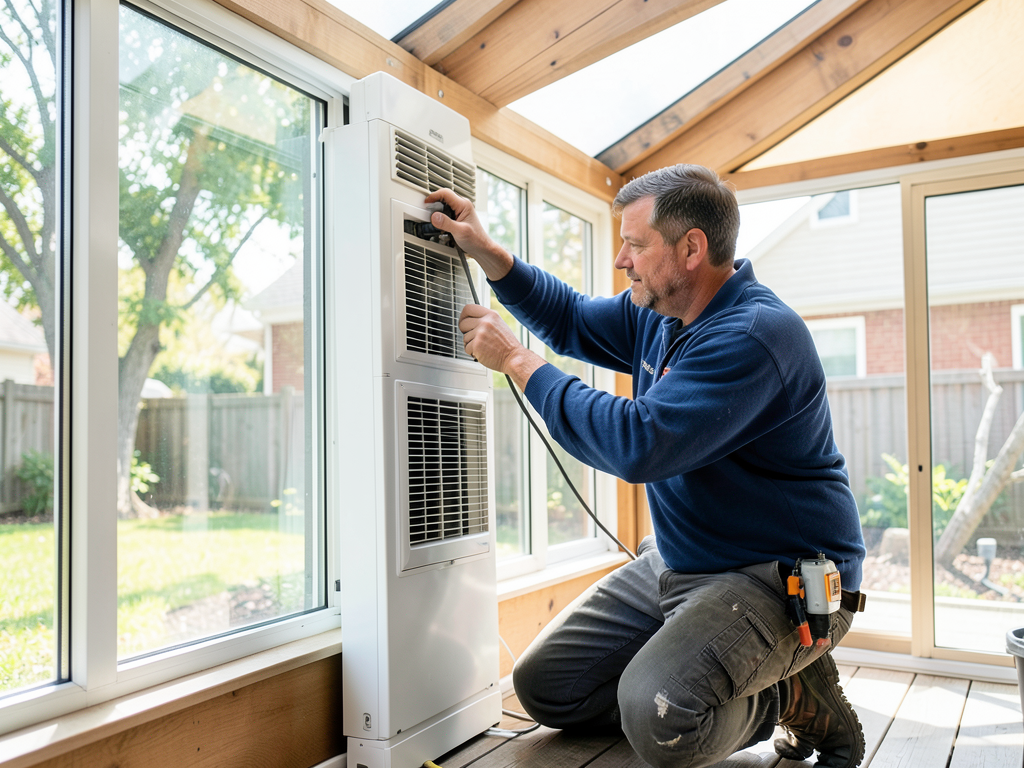
Installation requires mounting an indoor air handler on your sunroom wall and connecting it to an outdoor condenser unit. The refrigerant lines run through a small three-inch hole in your exterior wall. This minimally invasive process preserves your sunroom’s structure.
Zone control allows you to cool only the sunroom when needed. You can maintain 72 degrees in your sunroom while keeping the rest of your home at 78 degrees during summer months. This targeted approach reduces overall energy consumption.
Modern mini-splits include advanced filtration that removes pollen dust and other allergens. This feature proves especially valuable in Oaklandon where spring pollen counts often exceed 1500 grains per cubic meter.
Extending Your Existing HVAC System
Adding ductwork to your sunroom provides whole-home integration but presents significant challenges. Your existing system may lack the capacity to handle additional square footage especially during peak cooling demand.
Calculating load requirements helps determine if extension is feasible. Sunrooms typically need 25 to 35 BTU per square foot due to high solar gain. A 200-square-foot sunroom might require 5000 to 7000 BTU of additional cooling capacity.
Extending ductwork requires cutting into existing walls and ceilings. This process can damage finished surfaces and create new air leaks. Professional installation ensures proper sealing and insulation of new duct runs.
Zone dampers allow you to control airflow to the sunroom independently. These motorized dampers open and close based on thermostat signals preventing overcooling other areas when the sunroom demands cooling.
The cost of duct extension often exceeds mini-split installation. Labor for cutting drywall installing new ducts and refinishing surfaces adds significant expense. You also risk reducing efficiency in your main living areas.
Portable Cooling Units When They Make Sense
Portable air conditioners offer flexibility but come with limitations. These units work best for occasional use rather than daily comfort in Oaklandon’s humid summers.
Most portable units provide 8000 to 14000 BTU of cooling. They require venting through a window or wall opening. The exhaust hose can become hot radiating heat back into the room and reducing overall effectiveness.
Single-hose portable units create negative pressure that draws hot air from other areas into your sunroom. This effect can make the space feel warmer than before you turned on the unit. Dual-hose models avoid this problem but cost significantly more.
Noise levels often exceed 55 decibels creating a constant background hum. This volume proves distracting for activities like reading or watching television. The units also take up valuable floor space in your sunroom.
Maintenance requirements include emptying condensate tanks every few hours during humid weather. Some units offer continuous drainage but this requires access to a floor drain or external pump.
BTU Calculations for High-Gloss Rooms
Standard BTU calculators underestimate sunroom cooling needs. The high glass-to-wall ratio and solar exposure require adjustments to basic formulas.
Start with the square footage method multiply length by width to get area. Then multiply by 25 BTU for moderate sun exposure or 35 BTU for direct southern exposure. A 15 by 20-foot sunroom with southern exposure needs 10500 BTU minimum.
Add 1000 BTU for each window larger than 20 square feet. Oaklandon sunrooms often feature floor-to-ceiling glass panels that qualify for this adjustment. Large picture windows facing west require an additional 1500 BTU due to intense afternoon sun.
Factor in occupancy. Each person generates about 600 BTU of heat. If you entertain in your sunroom add 1200 BTU for two additional guests beyond the standard calculation.
High ceilings increase cooling requirements. Add 10 percent to your total BTU calculation for each foot of ceiling height above eight feet. A sunroom with 12-foot ceilings needs 40 percent more cooling capacity than one with standard heights.
Energy Rebates and Incentives in Indianapolis
Local utilities offer rebates that reduce the cost of energy-efficient cooling upgrades. AES Indiana provides rebates up to $400 for installing ENERGY STAR certified cooling equipment. Duke Energy offers similar programs for qualifying high-efficiency systems.
The federal ENERGY STAR program provides tax credits for qualifying HVAC equipment. As of 2026 homeowners can receive up to $300 in tax credits for installing certified central air conditioners or heat pumps.
Some manufacturers offer seasonal rebates on top of utility incentives. Mitsubishi Electric frequently provides $100 to $500 rebates on select mini-split systems during spring and fall promotion periods.
Local HVAC contractors often bundle rebate processing with installation services. This approach simplifies paperwork and ensures you receive all available incentives. Some companies guarantee they will secure maximum rebates or discount the difference. The Best AC Repair Services in Carmel for Modern Subdivisions.
Energy audits through your utility provider identify additional efficiency improvements. These assessments often qualify for free or reduced-cost services that complement your cooling upgrade.
Dehumidification Strategies for Indiana Summers
Temperature control alone cannot create comfort in Indiana’s humid climate. Dehumidification removes moisture from the air allowing your body to cool naturally through evaporation.
Whole-house dehumidifiers integrate with your existing HVAC system. These units can remove 70 to 135 pints of moisture per day. They work best when paired with variable-speed air handlers that run longer cycles at lower speeds.
Standalone dehumidifiers provide targeted moisture control for sunrooms. Look for units with continuous drainage options and automatic restart after power outages. Models rated for 50 pints per day can handle most sunroom applications.
Ventilation plays a crucial role in moisture management. Energy recovery ventilators (ERVs) exchange indoor air with fresh outdoor air while transferring heat and moisture between airstreams. This process maintains indoor air quality without sacrificing cooling efficiency.
Humidity sensors trigger cooling or dehumidification based on moisture levels rather than temperature alone. This approach prevents the clammy feeling that occurs when air conditioning cools without adequately removing humidity.
Smart Thermostats and Automation
Smart thermostats optimize sunroom cooling through learning algorithms and remote control. These devices track your usage patterns and adjust settings automatically to maximize comfort and efficiency.
Geofencing features detect when you approach your home and begin cooling your sunroom in advance. This ensures the space reaches your desired temperature by the time you arrive without running all day.
Integration with weather forecasts allows preemptive cooling adjustments. If the forecast predicts an unusually hot day your system can begin cooling earlier to maintain comfort without overworking during peak heat.
Voice control through Amazon Alexa or Google Assistant provides convenient temperature adjustments. You can modify settings without interrupting activities or searching for a remote control.
Energy usage reports help identify optimization opportunities. Smart thermostats track cooling cycles runtime and energy consumption. This data reveals patterns that suggest adjustments for improved efficiency.
Maintenance Requirements for Optimal Performance
Regular maintenance ensures your sunroom cooling system operates at peak efficiency. Dirty filters reduce airflow by up to 15 percent and increase energy consumption.
Clean or replace air filters every 30 to 60 days during cooling season. Oaklandon’s pollen levels mean more frequent changes may be necessary. Visual inspection helps determine when replacement is needed before efficiency drops. Affordable HVAC Replacement Options for Families in Noblesville.
Outdoor condenser units require clearance for proper airflow. Maintain at least two feet of clearance around the unit and five feet above it. Remove leaves grass clippings and other debris that accumulate on the coils.
Check refrigerant levels annually. Low refrigerant indicates leaks that reduce cooling capacity and increase energy costs. Professional technicians use electronic leak detectors to find small leaks before they cause major problems.
Inspect insulation on refrigerant lines. Damaged insulation causes condensation that can freeze and block refrigerant flow. Replace damaged insulation to maintain system efficiency.
Schedule professional tune-ups before cooling season begins. Technicians check electrical connections measure superheat and subcooling and verify proper system operation. This preventive maintenance catches problems before they cause discomfort.
Cost Comparison of Cooling Options
Understanding the total cost of ownership helps you make informed decisions about sunroom cooling. Initial installation costs vary significantly between options but operating costs often determine long-term value.
Portable air conditioners cost $300 to $600 initially but consume more electricity per BTU than other options. Operating costs typically range from $0.20 to $0.35 per hour depending on local electricity rates.
Ductless mini-splits require $2500 to $4500 for equipment and installation. These systems use 30 to 50 percent less electricity than portable units reducing operating costs to $0.10 to $0.20 per hour.
Extending existing ductwork costs $3000 to $7000 including labor and materials. Operating costs match your main HVAC system at $0.12 to $0.18 per hour but you may need system upgrades to handle the additional load.
Energy savings over five years often offset the higher initial cost of efficient systems. A mini-split that costs $1500 more than a portable unit can save $800 to $1000 in electricity over five years of regular use.
Consider maintenance costs when comparing options. Portable units require more frequent cleaning and have shorter lifespans. Professional maintenance for ductless systems costs $100 to $150 annually but extends equipment life to 15 to 20 years.
Seasonal Considerations for Year-Round Comfort
Sunroom cooling needs change throughout the year. Indiana’s four distinct seasons require different approaches to maintain comfort.
Spring brings high pollen counts that affect air quality and system efficiency. Install high-MERV filters rated MERV 11 or higher to capture pollen while maintaining adequate airflow. Replace filters more frequently during peak pollen seasons.
Summer demands maximum cooling capacity and dehumidification. Set thermostats to 75 degrees rather than 72 to reduce energy consumption while maintaining comfort. Each degree increase can reduce cooling costs by 3 to 5 percent.
Fall often provides natural cooling through mild temperatures. Use ceiling fans and open windows during comfortable days to reduce system runtime. This approach extends equipment life by reducing seasonal wear.
Winter requires heating solutions for year-round sunroom use. Mini-splits provide heating through heat pump technology operating efficiently down to 5 degrees Fahrenheit. This eliminates the need for separate heating systems. Reliable Heating and Cooling Experts Serving the Broad Ripple Area.
Insulation improvements benefit all seasons. Adding R-13 insulation to sunroom walls reduces heat gain in summer and heat loss in winter. Proper insulation can cut energy costs by 20 percent year-round.
Common Mistakes to Avoid
Many homeowners make costly mistakes when cooling their sunrooms. Understanding these pitfalls helps you avoid unnecessary expenses and comfort issues.
Undersizing cooling equipment ranks as the most common error. Homeowners often choose units based on square footage alone ignoring solar gain and ceiling height. This mistake results in systems that run continuously without achieving comfort.
Improper thermostat placement creates comfort problems. Installing thermostats near windows or in direct sunlight causes false readings that make systems cycle improperly. Locate thermostats on interior walls away from heat sources.
Neglecting maintenance reduces system efficiency and lifespan. Many homeowners forget that sunrooms require the same maintenance as main living areas. Dirty filters and coils can double energy consumption.
Choosing the wrong window treatments wastes cooling efforts. Dark-colored blinds absorb heat and radiate it into the room. Select light-colored reflective materials that block rather than absorb solar radiation.. Read more about Choosing the Right HVAC Setup for Your New Home Addition in Camby.
Ignoring humidity control creates clammy conditions even at comfortable temperatures. Indiana’s climate demands dehumidification capabilities beyond standard cooling. Systems without dedicated dehumidification struggle to maintain comfort.
Professional Assessment Benefits
Professional HVAC assessment provides accurate sizing and system recommendations. Technicians use Manual J calculations to determine precise cooling loads based on your specific sunroom characteristics.
Load calculations consider factors that DIY methods overlook. These include orientation shading from trees or buildings insulation levels and local climate data. Accurate calculations prevent oversizing or undersizing that affects comfort and efficiency.
Professional installation ensures proper system operation. Technicians verify refrigerant charge check airflow and test electrical connections. These steps prevent common problems that reduce efficiency and comfort.
Warranty protection requires professional installation for most HVAC equipment. DIY installation voids manufacturer warranties leaving you responsible for repair costs. Professional installation includes warranty registration and documentation.
Local code compliance affects system approval and insurance coverage. Professional contractors understand Indianapolis building codes and permit requirements. They ensure your installation meets all safety and efficiency standards.
Future-Proofing Your Sunroom Cooling
Technology advances rapidly in HVAC systems. Planning for future upgrades helps you avoid costly replacements as new options become available.
Choose equipment with upgradeable controls and communication capabilities. Systems that support Wi-Fi connectivity and smart home integration adapt to new technologies without replacing core components.
Consider solar readiness when planning cooling upgrades. Installing electrical circuits and roof mounting points during initial construction reduces future solar installation costs by 30 to 50 percent.
Energy storage integration becomes more viable as battery technology improves. Select systems compatible with future battery backup options. This compatibility ensures you can add energy independence as costs decrease.
Prepare for heat pump technology improvements. Current heat pumps work efficiently to 5 degrees Fahrenheit but ongoing research may extend this to -20 degrees. Choosing compatible infrastructure allows easy upgrades as technology advances.
Plan for electric vehicle charging integration. As EV adoption increases sunroom cooling systems may need to coordinate with vehicle charging to manage electrical loads and optimize energy use.
Making Your Final Decision
Selecting the right cooling solution requires balancing comfort needs budget constraints and long-term value. Consider your usage patterns and local climate when making your final choice.
Evaluate your typical sunroom use. If you use the space daily during summer invest in efficient permanent solutions. For occasional use portable units may provide adequate comfort at lower initial cost.
Consider your home’s existing HVAC infrastructure. If you have an older system nearing replacement age extending ductwork might make sense as part of a comprehensive upgrade. This approach avoids duplicate equipment.
Factor in local energy costs and availability. Indianapolis electricity rates average $0.13 per kilowatt-hour. Higher rates increase the value of efficient systems that reduce consumption.
Assess your DIY capabilities honestly. While some cooling improvements require professional installation others like window film application or ceiling fan installation work well as DIY projects.
Review local utility rebates and tax incentives. These programs can reduce effective costs by 20 to 40 percent making higher-efficiency options more affordable.
Plan for the long term. Quality cooling systems last 15 to 20 years. Choosing slightly more efficient equipment often pays for the difference through energy savings over the system’s lifetime.
Frequently Asked Questions
What size air conditioner do I need for my sunroom?
Sunrooms typically require 25 to 35 BTU per square foot due to high solar gain. A 200-square-foot sunroom needs 5000 to 7000 BTU minimum. Add 1000 BTU for each large window and 10 percent for high ceilings. Professional Manual J calculations provide the most accurate sizing.
Can I use my existing central air conditioning for my sunroom?
Extending existing ductwork may work if your system has adequate capacity. Most homes require 400 to 600 square feet of cooling per ton of capacity. Adding a sunroom often exceeds this limit requiring system upgrades or separate cooling equipment.
How much does it cost to cool a sunroom in Indianapolis?
Operating costs vary by system type. Portable units cost $0.20 to $0.35 per hour. Mini-splits cost $0.10 to $0.20 per hour. Ducted systems cost $0.12 to $0.18 per hour. Monthly costs during peak summer range from $50 to $150 depending on usage and efficiency.
Do I need a permit to install cooling in my sunroom?
Marion County requires permits for most HVAC installations. Mini-splits typically need electrical and mechanical permits. Duct extensions require building permits. Professional contractors handle permit applications and inspections as part of their services.
How long do sunroom cooling systems last?
Quality cooling systems last 15 to 20 years with proper maintenance. Portable units last 5 to 10 years. Mini-splits often reach 20 years. Regular maintenance including annual professional tune-ups and monthly filter changes maximizes equipment lifespan.
Ready to Cool Your Oaklandon Sunroom?
Your sunroom should be a comfortable retreat not a seasonal afterthought. Whether you need a complete cooling system installation or just want to explore your options professional guidance ensures you make the right choice for your specific situation.
Don’t let another Indiana summer pass with an unusable sunroom. Call (317) 688-8818 today to schedule your free assessment. Our NATE-certified technicians will evaluate your space explain your options and provide upfront pricing with no hidden fees.
We serve Oaklandon and all of Indianapolis with rapid response times and guaranteed satisfaction. Our team understands the unique challenges of cooling sunrooms in Central Indiana’s humid climate. We’ll help you create a comfortable space you can enjoy year-round.
Pick up the phone and call (317) 688-8818 before the next heat wave hits. Your comfortable sunroom awaits.
Additional Resources
For more information about energy efficiency and cooling options visit these trusted sources:
- U.S. Department of Energy – Cooling Your Home
- ENERGY STAR – Energy Efficient Products
- AES Indiana – Energy Rebates and Incentives
{
“@context”: “https://schema.org”,
“@type”: “BlogPosting”,
“headline”: “The Best Ways to Keep Your Oaklandon Sunroom Comfortable All Year Round”,
“description”: “Keep your Oaklandon sunroom cool and comfortable with expert cooling solutions for Indiana’s humid summers. Learn about mini-splits, passive cooling, and energy rebates.”,
“wordCount”: 3259,
“datePublished”: “2026-04-17T09:57:00.000Z”,
“dateModified”: “2026-04-17T09:57:00.000Z”,
“inLanguage”: “en-US”,
“mainEntityOfPage”: {
“@type”: “WebPage”,
“@id”: “https://reliancehvacindianapolis.com”
},
“publisher”: {
“@type”: “LocalBusiness”,
“name”: “Reliance HVAC Indianapolis”,
“url”: “https://reliancehvacindianapolis.com”
},
“author”: {
“@type”: “Organization”,
“name”: “Reliance HVAC Indianapolis”,
“url”: “https://reliancehvacindianapolis.com”
},
“image”: {
“@type”: “ImageObject”,
“url”: “https://reliancehvacindianapolis.com/wp-content/uploads/2026/03/the-best-ways-to-keep-your-oaklandon-sunroom-comfo-1.png”
}
}
{
“@context”: “https://schema.org”,
“@type”: “HVACBusiness”,
“name”: “Reliance HVAC Indianapolis”,
“url”: “https://reliancehvacindianapolis.com”,
“address”: {
“@type”: “PostalAddress”,
“addressLocality”: “Indianapolis”
},
“areaServed”: {
“@type”: “City”,
“name”: “Indianapolis”
}
}
{
“@context”: “https://schema.org”,
“@type”: “FAQPage”,
“mainEntity”: [
{
“@type”: “Question”,
“name”: “What size air conditioner do I need for my sunroom?”,
“acceptedAnswer”: {
“@type”: “Answer”,
“text”: “Sunrooms typically require 25 to 35 BTU per square foot due to high solar gain. A 200-square-foot sunroom needs 5000 to 7000 BTU minimum. Add 1000 BTU for each large window and 10 percent for high ceilings. Professional Manual J calculations provide the most accurate sizing.”
}
},
{
“@type”: “Question”,
“name”: “Can I use my existing central air conditioning for my sunroom?”,
“acceptedAnswer”: {
“@type”: “Answer”,
“text”: “Extending existing ductwork may work if your system has adequate capacity. Most homes require 400 to 600 square feet of cooling per ton of capacity. Adding a sunroom often exceeds this limit requiring system upgrades or separate cooling equipment.”
}
},
{
“@type”: “Question”,
“name”: “How much does it cost to cool a sunroom in Indianapolis?”,
“acceptedAnswer”: {
“@type”: “Answer”,
“text”: “Operating costs vary by system type. Portable units cost $0.20 to $0.35 per hour. Mini-splits cost $0.10 to $0.20 per hour. Ducted systems cost $0.12 to $0.18 per hour. Monthly costs during peak summer range from $50 to $150 depending on usage and efficiency.”
}
},
{
“@type”: “Question”,
“name”: “Do I need a permit to install cooling in my sunroom?”,
“acceptedAnswer”: {
“@type”: “Answer”,
“text”: “Marion County requires permits for most HVAC installations. Mini-splits typically need electrical and mechanical permits. Duct extensions require building permits. Professional contractors handle permit applications and inspections as part of their services.”
}
},
{
“@type”: “Question”,
“name”: “How long do sunroom cooling systems last?”,
“acceptedAnswer”: {
“@type”: “Answer”,
“text”: “Quality cooling systems last 15 to 20 years with proper maintenance. Portable units last 5 to 10 years. Mini-splits often reach 20 years. Regular maintenance including annual professional tune-ups and monthly filter changes maximizes equipment lifespan.”
}
},
{
“@type”: “Question”,
“name”: “Ready to Cool Your Oaklandon Sunroom?”,
“acceptedAnswer”: {
“@type”: “Answer”,
“text”: “Your sunroom should be a comfortable retreat not a seasonal afterthought. Whether you need a complete cooling system installation or just want to explore your options professional guidance ensures you make the right choice for your specific situation.”
}
}
]
}
{
“@context”: “https://schema.org”,
“@type”: “BreadcrumbList”,
“itemListElement”: [
{
“@type”: “ListItem”,
“position”: 1,
“name”: “Home”,
“item”: “https://reliancehvacindianapolis.com”
},
{
“@type”: “ListItem”,
“position”: 2,
“name”: “Blog”,
“item”: “https://reliancehvacindianapolis.com/blog”
},
{
“@type”: “ListItem”,
“position”: 3,
“name”: “The Best Ways to Keep Your Oaklandon Sunroom Comfortable All Year Round”
}
]
}
{
“@context”: “https://schema.org”,
“@type”: “Service”,
“serviceType”: “HVAC”,
“provider”: {
“@type”: “LocalBusiness”,
“name”: “Reliance HVAC Indianapolis”,
“url”: “https://reliancehvacindianapolis.com”
},
“areaServed”: {
“@type”: “City”,
“name”: “Indianapolis”
},
“description”: “Keep your Oaklandon sunroom cool and comfortable with expert cooling solutions for Indiana’s humid summers. Learn about mini-splits, passive cooling, and energy rebates.”
}